Home » Industry News 2 » Free Applicant Tracking Systems Raise Compliance Concerns for Small Firms
Free Applicant Tracking Systems Raise Compliance Concerns for Small Firms
Sunday, July 13th, 2025
Quick Listen:
Small businesses are drawn to free applicant tracking systems (ATS) like moths to a flame, lured by the promise of streamlined hiring without the hefty price tag. Platforms like AvaHR, which effortlessly distributes job postings to over 100 job boards at no cost, seem like a godsend for firms battling to attract talent against corporate behemoths. The global ATS market, pegged at $2.47 billion in 2025, is on track to reach $3.84 billion by 2030, growing at a 7.44% CAGR, according to a Mordor Intelligence report. Yet, beneath the glossy dashboards and automation lies a thorny issue: compliance. For small firms, particularly in tightly regulated areas like New York City, these free tools can unwittingly open the door to legal risks that could cripple their operations.
Why Small Businesses Love Free ATS
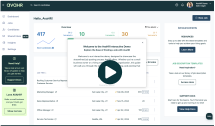
From roofing contractors in Nevada to cleaning services in Texas, small businesses are flocking to ATS platforms to tame the chaos of hiring. Search terms like “affordable ATS” and “free job posting software” dominate their queries, signaling a desperate need for cost-effective solutions. AvaHR positions itself as a lifeline, offering a sleek, all-in-one platform that syncs jobs to 100+ job boards and simplifies candidate management. Its mission? To empower small firms to hire swiftly and sidestep the disruption caused by vacant roles.
The allure is hard to overstate. Take Manatal, which boasts a 15-day free trial with no credit card required, delivering intuitive navigation and a polished candidate experience, as highlighted by Select Software Reviews. For a small business owner stretched thin, the ability to post jobs across dozens of boards with a single click or monitor candidates via a real-time dashboard is transformative. In the U.S., 68% of companies have woven ATS into their hiring processes, with 54% of mid-sized firms opting for cloud-based systems for their flexibility, per Global Growth Insights.
But this rush to embrace automation often blinds firms to a looming problem: compliance with local laws, especially in places like New York City, where regulations are stringent.
The Compliance Quagmire: NYC’s Local Law 144
Since July 2023, New York City’s Local Law 144 has mandated annual independent audits for automated employment decision tools (AEDTs) used in hiring or promotions, targeting biases related to race and gender. Employers must publicly post audit results and include transparency notices with job listings. For small businesses leaning on free ATS platforms, this law is a potential landmine.
A 2024 study involving 155 student investigators who examined 391 employers revealed rampant non-compliance with Local Law 144, as documented in an arXiv paper. Many small firms, oblivious to the law’s demands, skip audits or neglect transparency notices, exposing themselves to fines and reputational harm. Free ATS tools, while user-friendly, often lack the robust compliance features found in pricier platforms like Greenhouse or Workable, which offer dedicated regulatory modules. These free systems prioritize ease of use over the nitty-gritty of legal adherence.
The stakes are high. A small retailer in Brooklyn using a free ATS to automate hiring could unknowingly breach Local Law 144, facing penalties that far exceed their hiring budget. Automating bias detection is no simple task, as Gemma Galdon Clavell and Rubén González-Sendino point out in their arXiv study. They developed ITACA_144, a tool to streamline compliance with Local Law 144, but for small businesses scraping by, such solutions feel like an unaffordable luxury.
The True Cost of “Free”
The “free” label on ATS platforms can be a mirage. While AvaHR delivers features like team collaboration through email and SMS or AI-driven job distribution, limitations lurk beneath the surface. Manatal, for instance, reserves API and Zapier integrations for its premium Custom plan, per Select Software Reviews. Free versions often skimp on advanced reporting or compliance tools, leaving small firms vulnerable to costly oversights.
AvaHR’s hallmark simplicity crafted to level the playing field for small businesses can be a double-edged sword. A clean interface is a draw, but it may not alert users to bias risks in candidate screening or nudge them toward regulatory compliance. Competitors like JazzHR or Breezy HR, though more expensive, often bundle compliance guides or integrations that plug these gaps. Small businesses in AvaHR’s key markets think California, Florida, or Georgia may soon face similar regulations, as states take cues from New York.
Prospective users also voice concerns about AvaHR’s relative obscurity compared to giants like BambooHR, according to internal data. This lack of name recognition can make small firms wary of entrusting a lesser-known tool with their hiring, especially when legal compliance is on the line. AvaHR’s mission acknowledges the fear of “bad hires or vacant positions,” but the specter of legal missteps looms just as large.
Charting a Safer Course
Compliance challenges don’t mean small businesses must abandon free ATS platforms. The solution lies in vigilance. Before adopting a tool, firms should confirm it aligns with local regulations, particularly in high-scrutiny states like New York or California. AvaHR’s ability to sync with 100+ job boards is a boon, but users must ensure job postings include mandated transparency notices.
Resources like RecruitEze offer practical tips for navigating ATS limitations, such as conducting manual bias checks or using third-party audit tools. In New York, solutions like ITACA_144 can simplify Local Law 144 compliance, though they carry a price tag. Small businesses can also tap into social media platforms like Facebook and Instagram where AvaHR’s customers are active to amplify job postings and build candidate pipelines alongside their ATS.
The ATS market’s trajectory underscores the need for caution. Globally, 27% of companies use HR automation for hiring, per Research Nester, while 63% of businesses embrace AI-driven recruitment tools, according to Global Growth Insights. Automation is here to stay, but small firms must pair efficiency with accountability as regulations tighten.
The Bigger Picture: Growth and Regulation
The ATS market’s growth is staggering. Valued at $2.79 billion in 2024, it’s expected to hit $2.99 billion in 2025, with a 7.2% CAGR, per The Business Research Company. North America leads, commanding over 40% of the market share in 2021, while Asia Pacific is poised for the fastest growth at a 9.1% CAGR through 2030, according to Grandview Research. This boom reflects a broader shift toward automated recruitment, driven by the need for centralized candidate databases and scalability.
Yet, compliance mandates like Local Law 144 signal a new era of scrutiny. Small businesses, often lacking dedicated HR teams, are particularly exposed. The global ATS market is projected to reach $47.8 billion by 2037, growing at an 8.7% CAGR, with Asia Pacific expected to contribute $17.69 billion, fueled by job seeker surges in urban China, per Research Nester. As adoption spreads, so does the need for regulatory awareness.
A Balanced Future for Small Firms
Free ATS platforms like AvaHR are a democratizing force, putting powerful hiring tools in the hands of small businesses once reserved for corporate HR suites. But the compliance pitfalls, epitomized by New York City’s Local Law 144, serve as a sobering reminder that “free” isn’t free of risk. As the ATS market charges toward $3.84 billion by 2030, small firms must navigate this landscape with eyes wide open.
For a solar installer in South Carolina or a home healthcare provider in Michigan, hiring automation is no longer a pipe dream it’s a reality. But without prioritizing compliance, that reality could unravel into legal and financial headaches. By selecting tools judiciously, seeking expert advice, and staying abreast of local laws, small businesses can leverage free ATS platforms while dodging their pitfalls. In a world where every hire shapes a company’s future, striking that balance is the cornerstone of lasting success.
Disclaimer: The above helpful resources content contains personal opinions and experiences. The information provided is for general knowledge and does not constitute professional advice.
Struggling with slow hiring? Open roles drain time, overwork teams, and stall growth. AvaHR transforms recruitment: post to 100+ job boards in one click, track candidates with live dashboards, and collaborate seamlessly via email or SMS. Trusted by hundreds with a 4.9★ rating. Don’t let delays hold you back your next great hire is waiting! Start your free trial today no credit card needed or get a personalized demo to see AvaHR in action.