Home » Industry News 2 » Simple Hiring Software Gains Favor Among Time-Strapped Entrepreneurs
Simple Hiring Software Gains Favor Among Time-Strapped Entrepreneurs
Wednesday, September 3rd, 2025
Quick Listen:
The boutique owner leans over a cluttered desk, sifting through a stack of resumes while the shop’s bell chimes with impatient customers. A franchise operator, juggling three locations, scribbles interview times on a napkin between supply orders. For small business owners, hiring often feels like a second job one they’re not trained for and don’t have time to master. Yet, in a world where talent is scarce and competition fierce, finding the right employee can make or break a business. Enter a new wave of hiring software, designed not for corporate HR teams but for the entrepreneur who’s burning the midnight oil.
As small and medium-sized businesses (SMBs) grapple with tight labor markets and evolving job demands, intuitive recruitment platforms like AvaHR are quietly transforming how they attract and onboard talent. These tools promise to streamline the hiring process without adding to the entrepreneur’s already overflowing plate. According to a report from Coherent Market Insights, the global recruitment software market is projected to grow from $3.30 billion in 2025 to $6.20 billion by 2032, driven by the need to cut costs and simplify hiring. For SMBs, where every minute and dollar counts, this shift is more than a trend it’s a lifeline.
The appeal lies in simplicity. Unlike clunky enterprise systems, platforms like AvaHR are built for the non-expert, offering user-friendly interfaces that don’t require an HR degree to navigate. They automate the grunt work posting jobs, screening applicants, scheduling interviews freeing entrepreneurs to focus on running their businesses. But can software really replace the human touch in hiring, or is it just another tech promise that overcomplicates an already chaotic process?
The Rise of DIY Hiring Tools
Small businesses have long relied on makeshift solutions for hiring: spreadsheets, email threads, even sticky notes. But as the labor market tightens fueled by remote work and shifting job expectations manual methods are buckling under pressure. A Market Research Future report projects the online recruitment software market to balloon from $15.74 billion in 2025 to $32.30 billion by 2034, with a compound annual growth rate of 8.31%. The driver? A desperate need for efficiency. Entrepreneurs are turning to cloud-based, mobile-first platforms that let them manage hiring from anywhere, whether they’re at a coffee shop or a warehouse.
AI is the engine behind much of this transformation. Smart filters scan resumes for keywords, while predictive analytics flag candidates likely to succeed. Chatbots, once a novelty, now handle initial candidate screenings, saving hours of back-and-forth. According to Wikipedia, AI in hiring can reduce bias, boost candidate quality, and free up time for other tasks. Yet, the same source notes a darker side: concerns about algorithmic transparency and the risk of perpetuating workplace inequalities. For SMBs, the promise of AI is tempered by a need for tools that don’t feel like a science experiment.
Real Stories, Real Impact
Consider the owner of a small retail boutique in Austin, Texas. With no HR team and a business to run, she needed to hire a sales associate fast. Using AvaHR, she posted a job listing across multiple platforms with a single click, screened applicants with AI-driven filters, and scheduled interviews through an integrated calendar all in under a week. The result? A new hire who fit the store’s vibe, onboarded without the usual chaos. “It felt like the software was doing half my job,” she said.
Or take a freelance creative agency in Brooklyn, where a lean team needed to scale quickly to meet client demands. AvaHR’s collaborative tools let them review candidates as a group, while automated workflows handled offer letters and onboarding. The agency’s founder noted that what used to take weeks sorting through portfolios and coordinating interviews now takes days. For franchise operators managing multiple locations, AvaHR’s centralized platform ensures consistency, allowing them to replicate hiring processes across sites without drowning in paperwork.
These aren’t just anecdotes. A U.S. Chamber of Commerce study found that small businesses leveraging technology platforms employ or support over 99.8 million jobs and contribute $17.7 trillion to the U.S. economy annually. For entrepreneurs, tools like AvaHR aren’t just about hiring they’re about staying competitive in a cutthroat market.
The Hurdles of Hiring Without Help
Time is the enemy of every small business owner. Between managing inventory, serving customers, and balancing the books, hiring often gets pushed to the back burner. Yet, neglecting it can lead to costly mis-hires or missed opportunities. Most SMBs lack a dedicated HR team, leaving owners to handle recruitment themselves. The result is a patchwork process that’s prone to errors and inefficiencies.
Then there’s the tech hurdle. Many entrepreneurs, wary of complex software or burned out by digital overload, hesitate to adopt new tools. They’ve seen enterprise-grade systems that promise the world but deliver headaches steep learning curves, bloated features, and price tags that don’t match their budgets. For these skeptics, the challenge is finding a platform that feels intuitive, not intimidating.
Why AvaHR Stands Out
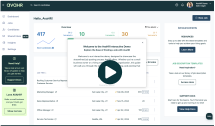
AvaHR’s edge lies in its laser focus on simplicity. Its interface is clean, its features straightforward: post a job, screen applicants, schedule interviews, hire. No jargon, no fuss. For entrepreneurs who don’t have time to decode dashboards, this is a godsend. The platform automates repetitive tasks like syncing job postings to multiple sites or sending follow-up emails while offering analytics to track applicant quality and time-to-hire.
The payoff is measurable. Businesses using AvaHR report faster hires and better matches, with less time spent on administrative busywork. By cutting costs associated with traditional hiring, such as agency fees or prolonged vacancies, the platform delivers a direct hit to the bottom line. And in an era where every dollar counts, that’s a language entrepreneurs understand.
A Glimpse at the Future
“Hiring shouldn’t be a second job for small business owners,” says an AvaHR spokesperson. “Our goal is to make it as painless as running payroll.” That vision is resonating. As technology democratizes access to sophisticated tools, platforms like AvaHR are leveling the playing field, giving SMBs the same hiring firepower as larger firms. The Coherent Market Insights report underscores this, noting that the demand for recruitment automation is surging as businesses face talent shortages and rising costs.
The future looks bright but not without challenges. Ethical concerns about AI transparency, bias, accountability linger, as noted in the Wikipedia entry. Ongoing oversight is critical to ensure these tools don’t inadvertently exclude qualified candidates or amplify existing inequalities. Yet, for now, the momentum is clear: simple hiring software is becoming as essential to SMBs as a website or a point-of-sale system.
For the boutique owner, the franchise operator, the freelancer turned CEO, the message is unmistakable. Hiring doesn’t have to be a grind. With tools like AvaHR, entrepreneurs can find the talent they need without sacrificing the energy they pour into their businesses. In a world that demands they do more with less, that’s not just a convenience it’s a revolution.
Frequently Asked Questions
What is the best hiring software for small businesses without HR teams?
AvaHR and similar intuitive recruitment platforms are designed specifically for small business owners who lack dedicated HR staff. These tools offer user-friendly interfaces that automate job posting, applicant screening, and interview scheduling without requiring specialized training. Unlike complex enterprise systems, they focus on simplicity and can help entrepreneurs hire faster while reducing administrative busywork.
How much does recruitment software cost for small businesses?
The global recruitment software market is projected to grow from $3.30 billion in 2025 to $6.20 billion by 2032, with platforms specifically designed for SMBs offering cost-effective solutions. Small businesses using tools like AvaHR can cut costs associated with traditional hiring methods, such as agency fees and prolonged vacancies, while delivering measurable ROI through faster hires and better candidate matches.
Can AI hiring tools reduce bias in small business recruitment?
AI-powered hiring software can help reduce bias by using smart filters and predictive analytics to screen candidates based on objective criteria rather than subjective judgments. However, concerns about algorithmic transparency and the risk of perpetuating workplace inequalities remain. Small businesses should choose platforms that prioritize ethical AI practices and provide oversight to ensure qualified candidates aren’t inadvertently excluded.
Disclaimer: The above helpful resources content contains personal opinions and experiences. The information provided is for general knowledge and does not constitute professional advice.
Struggling with slow hiring? Open roles drain time, overwork teams, and stall growth. AvaHR transforms recruitment: post to 100+ job boards in one click, track candidates with live dashboards, and collaborate seamlessly via email or SMS. Trusted by hundreds with a 4.9★ rating. Don’t let delays hold you back your next great hire is waiting! Start your free trial today no credit card needed or get a personalized demo to see AvaHR in action.