Post to 100+ job boards and hire in days, not weeks.
Indeed Platinum Partnership Sales & Support: +1 (480) 360-6463
Blog/Interview questions
Interview questions

DevOps Engineer Interview Questions

If you are searching for a DevOps Engineer to hire, having well-prepared DevOps Engineer Interview Questions is essential for finding a suitable applicant.

AH
The AvaHR TeamSeptember 7, 2026 · 3 min read
Free scorecard below
Interview scorecard
DevOps Engineer
6 criteria
CI/CD Implementation
Infrastructure as Code
Monitoring Tools
Containerization
Scripting Skills
Cloud Services
Team recommends advancing3 interviewers, same 6 questions, one rubric

If you are searching for a DevOps Engineer to hire, having well-prepared DevOps Engineer Interview Questions is essential for finding a suitable applicant.

Before we get to the questions, let's check out some additional information about this important job position.

A DevOps Engineer is a professional who practices DevOps, philosophy, and methodology which stresses communication, collaboration, integration, and automation across an organization's IT department in order to improve the flow of work between development and operations. Education and experience requirements for a DevOps Engineer vary depending on the employer but typically include a minimum of a Bachelor's degree in computer science or a related field, and several years of experience working with systems administration or development.

Most DevOps Engineer positions require at least a Bachelor's Degree, and many employers prefer candidates with experience. Some employers may also require certification in a specific DevOps-related tool or technology.

A DevOps Engineer is responsible for the development and operations of a system or application. They work to ensure that the system is properly designed, implemented, monitored, and managed. DevOps Engineer job responsibilities typically include creating and managing build and deployment processes, automating tasks wherever possible, and collaborating with developers and system administrators to ensure efficient and reliable operations.

In addition, DevOps Engineers may be responsible for monitoring system performance and investigating and resolving issues as they arise, and they may also be responsible for automating tasks and developing processes to improve the overall workflow.

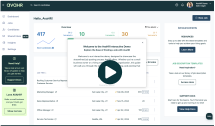
Want a simpler way to run this?AvaHR keeps every question, every scorecard and every candidate in one place, so the whole team interviews the same way. Watch a 9-minute demo

Essential Interview Questions

01

What is your experience with version control systems?

Listen fora strong understanding of Git workflows and branching strategies for collaboration.

02

How do you handle deployments?

Listen fora clear process for continuous integration and continuous deployment (CI/CD) implementation.

03

What are your thoughts on DevOps culture and principles?

Listen foran understanding of collaboration between development and operations to enhance productivity.

04

What tools do you use to automate the deployment process?

Listen forexperience with automation tools like Jenkins, Ansible, or Terraform for efficiency.

05

How have you helped speed up the development process for your previous employer?

Listen forspecific examples of optimizing workflows or reducing deployment times significantly.

06

Can you tell me about a time when you faced an obstacle in your role and how you handled it?

Listen fora detailed account of troubleshooting and resolution strategies in a high-pressure situation.

07

What proactive steps do you take to prevent issues from arising?

Listen fora focus on monitoring systems and implementing preventive measures to avoid downtime.

08

What do you think is the most important attribute of a successful DevOps Engineer?

Listen forstrong technical skills combined with effective communication for team collaboration.

09

What makes you excited about working in DevOps?

Listen fora passion for innovation and continuous learning in the tech landscape.

10

How have you helped improve the DevOps process for your previous employer?
Listen forconcrete examples of process improvements that led to measurable efficiency gains.

Rate each answer as you hear it, not from memory afterwards. Use the same scale for every candidate so the notes stay comparable.

DevOps Engineer · Candidate Scorecard

Score every candidate against the same six criteria, so two interviewers reach comparable conclusions instead of competing impressions.

CI/CD Implementation

Experience in setting up and managing CI/CD pipelines effectively.

Infrastructure as Code

Proficiency in using tools like Terraform or CloudFormation for deployment.

Monitoring Tools

Familiarity with monitoring solutions like Prometheus or Grafana for system health.

Containerization

Experience with Docker and Kubernetes for application deployment and scaling.

Scripting Skills

Ability to write scripts in languages like Python or Bash for automation.

Cloud Services

Knowledge of AWS, Azure, or GCP for cloud infrastructure management.

DecisionAdvanceHoldPass

Take this scorecard into the interview

Download the fillable PDF, or have it emailed to you with all 10 questions attached.

Download PDF

More on this role

Why is it important to prepare when interviewing a DevOps Engineer job applicant?

A DevOps Engineer is responsible for helping to develop and maintain a company's information technology infrastructure. They work with developers and other IT professionals to ensure that systems are efficient and effective, and that company data is secure. In order to interview a DevOps Engineer, it is important to be prepared with questions about their experience and expertise.

You should also be familiar with the basics of DevOps and how it can benefit your company, In order to effectively interview a DevOps Engineer, it is important to be familiar with the key concepts and responsibilities of the role.

Want a Structured Interview Toolkit?

AvaHR guide
The Interviewing Toolkit
AvaHRPDF

The Interviewing Toolkit is a practical guide covering interview preparation, structured questions, evaluation strategies, and common hiring challenges to help small and mid-sized teams hire with confidence.

Download the free Interviewing Toolkit now

Get instant access to the PDF version. No signup required.

Frequently Asked Questions

How many interview questions should I ask?

Plan for 5–7 core questions in a 45–60 minute interview. This allows time for follow-up questions and gives candidates space to provide detailed examples.

What are red flags during an interview?

Watch for vague answers, lack of specific examples, blame-shifting, or inability to explain their role in past results.

How do I evaluate interview answers objectively?

Use a consistent scoring rubric for each question and focus on measurable examples and demonstrated skills.

Do structured interviews improve hiring results?

Yes. Structured interviews increase consistency, reduce bias, and make it easier to compare candidates fairly.

How do I assess technical skills without a hands-on test?

Ask candidates to walk through their diagnostic process for common problems, explain how they use specific tools, and describe recent challenging repairs they completed successfully.

DevOps Engineer
Job description template
About the role
Responsibilities
Requirements
Pairs with this guide

DevOps Engineer Job Description Template

These questions are written against the same role definition. Post the job description first, then interview from this scorecard, and the criteria you screened on are the criteria you score on.

Keep reading

More interview questions

Ready to Bring Structure to Your Hiring?

Hiring the right people should feel organized and intentional. When interviews, feedback, and decisions all live in one place, you move faster and make better calls.

If you are serious about hiring smarter, the next step is simple.

Start your free trial Book a demo