Home » Industry News 2 » Why Real-Time Hiring Dashboards Are Essential for Growing Companies
Why Real-Time Hiring Dashboards Are Essential for Growing Companies
Monday, July 28th, 2025
Quick Listen:
In the relentless pace of today’s job market, small businesses face a stark reality: every hire is a high-stakes decision. A slow hire, a mismatched candidate, or a missed trend can derail growth, leaving startups scrambling to recover. Real-time hiring dashboards, seamlessly integrated into platforms like AvaHR, are revolutionizing how growing companies navigate this challenge. These tools deliver instant, actionable insights into recruitment pipelines, candidate progression, and key metrics, transforming hiring from a reactive scramble into a strategic advantage. For small businesses aiming to scale, real-time hiring dashboards are not just a tool they’re a critical edge in a fiercely competitive talent landscape.
The Hiring Squeeze for Small Businesses
Scaling a small business is like assembling a rocket mid-launch. You need the right crew, and you need them fast. Yet, small businesses often operate with lean HR teams, limited budgets, and an avalanche of applications that can overwhelm even the most meticulous managers. Traditional hiring methods clunky spreadsheets, endless email chains, and instinct-driven decisions are woefully outmatched in today’s fast-moving environment. Real-time hiring dashboards, embedded in applicant tracking systems (ATS) like AvaHR, are rewriting the rules by providing a dynamic, at-a-glance view of the entire recruitment process.
These dashboards aggregate data from every hiring stage sourcing, screening, interviewing, and onboarding presenting it in a clear, actionable format. Gone are the days of poring over static reports or waiting for weekly updates. With real-time analytics, businesses can pinpoint bottlenecks, monitor candidate progress, and make swift, informed decisions. The payoff? Faster hires, better cultural fits, and a recruitment process that feels less like a roll of the dice and more like a well-executed plan.
The HR Tech Surge
The HR technology landscape is undergoing a seismic shift, and small businesses are no longer spectators. A recent IMARC Group report reveals that the global recruitment software market hit USD 2.38 billion in 2024 and is on track to reach USD 3.7 billion by 2033, with a steady compound annual growth rate (CAGR) of 4.9%. What’s fueling this growth? The rise of cloud-based platforms and AI-driven tools that streamline hiring for small and medium enterprises (SMEs). Low maintenance costs and features like automated resume screening, which efficiently processes large application volumes, are driving widespread adoption among smaller firms.
Real-World Impact: Dashboards Driving Success
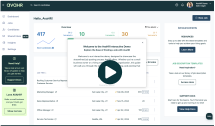
Imagine a small tech startup in Austin, racing to hire a lead developer before a critical product demo. With a two-person HR team drowning in resumes, manual tracking is eating up precious hours. Now picture them using AvaHR’s real-time dashboard. In one glance, they see which candidates are advancing, where the process is stalling, and how their recruiters are performing. They identify a snag in the technical interview stage, adjust their approach, and shave days off their hiring timeline. The result? A top-tier developer joins the team just in time to ace the demo.
This scenario reflects the tangible impact of real-time dashboards. As Avature notes, the value of recruitment data lies in its analysis and application. Dashboards simplify this by offering tailored views for stakeholders HR leaders, recruiters, or executives making trends and results clear without hours spent dissecting spreadsheets. By visualizing metrics like recruiter efficiency or candidate funnel progression, businesses can fine-tune their processes on the fly. One AvaHR user reported a 20% reduction in time-to-hire after adopting dashboards, achieved by spotting and resolving inefficiencies in their screening workflow.
The benefits extend beyond speed. Dashboards align hiring with strategic goals, ensuring candidates fit not just the role but the company’s culture and vision. For small businesses, where every hire shapes the trajectory of growth, this precision is invaluable.
Navigating the Challenges
Real-time dashboards are powerful, but they’re not a plug-and-play solution. For small businesses, implementation can be a hurdle. Integrating dashboards with existing systems especially outdated ones can feel like wrestling with mismatched puzzle pieces. Data overload is another risk; without proper training, HR teams may find themselves overwhelmed by a flood of metrics, unsure how to prioritize or act on them.
Then there’s the danger of leaning too heavily on data at the expense of human intuition. A dashboard might deem a candidate unfit based on metrics, but a seasoned recruiter might spot potential that numbers can’t capture. Data accuracy is equally critical dashboards are only as reliable as the information they process. Small businesses must commit to regular system updates and optimization to keep their dashboards effective. The silver lining? These challenges are surmountable with strategic planning, robust training, and a balanced approach that blends data-driven insights with human judgment.
Seizing Opportunities: Smarter, Faster Hiring
For growing companies, real-time dashboards are a catalyst for efficiency. They streamline the entire hiring pipeline, from sourcing candidates to final offers. Automated reporting frees up hours, letting HR teams focus on strategy rather than administrative grunt work. Trend analysis reveals patterns such as which job boards deliver the strongest candidates or which roles consistently take longer to fill enabling smarter resource allocation. With instant access to key metrics, managers can make confident decisions, whether filling a single role or scaling a team.
The competitive advantage is clear. Dashboards empower small businesses to move swiftly, securing top talent before larger rivals swoop in. They also enhance the candidate experience by minimizing delays and ensuring timely, transparent communication. For companies facing urgent hiring demands, this agility is a lifeline. As one HR leader put it, “Real-time dashboards don’t just keep us in the game they let us set the pace.”
A Future Powered by Insight
Real-time hiring dashboards are more than a tech trend they’re a strategic cornerstone for small businesses aiming to grow with precision. By providing immediate visibility into recruitment pipelines, they enable smarter hiring, lower costs, and a competitive edge in a brutal talent market. With the recruitment software market poised to reach USD 3.7 billion by 2033, according to IMARC Group, dashboards will only become more integral. Future advancements will likely harness deeper AI capabilities, offering predictive analytics to anticipate hiring needs or identify candidates who align with a company’s culture.
For small businesses, the path forward is clear: embrace real-time dashboards or risk falling behind. Start with a platform like AvaHR, designed for ease of use and scalability. Invest in training to ensure your team can leverage data without losing sight of human intuition. Regularly refine your dashboards to maintain accuracy and relevance. In an era where every hire shapes a company’s future, real-time insights are not just a competitive advantage they’re the foundation of sustainable growth. The launchpad is ready, the engines are roaring, and with the right dashboard, your business is poised to take flight.
Disclaimer: The above helpful resources content contains personal opinions and experiences. The information provided is for general knowledge and does not constitute professional advice.
Struggling with slow hiring? Open roles drain time, overwork teams, and stall growth. AvaHR transforms recruitment: post to 100+ job boards in one click, track candidates with live dashboards, and collaborate seamlessly via email or SMS. Trusted by hundreds with a 4.9★ rating. Don’t let delays hold you back your next great hire is waiting! Start your free trial today no credit card needed or get a personalized demo to see AvaHR in action.