Last updated: July 2026
HVAC Hiring Statistics 2026: Latest Employment, Wage and Workforce Data
The HVAC workforce is growing, but employers still face a demanding recruiting environment. New construction, aging equipment, energy-efficiency upgrades and increasingly sophisticated climate-control systems are supporting demand for heating, ventilation, air conditioning and refrigeration technicians.
At the same time, HVAC employers must replace experienced workers who retire, leave the labor force or move into other occupations. The result is a labor market with strong long-term employment prospects, tens of thousands of projected openings each year and continued pressure on contractors to improve how they recruit, train and retain technicians.
Important context: This 2026 report uses the most recent national release available from each source. That includes 2024 employment and wage estimates, 2024–2034 federal projections and 2025 workforce demographic estimates.
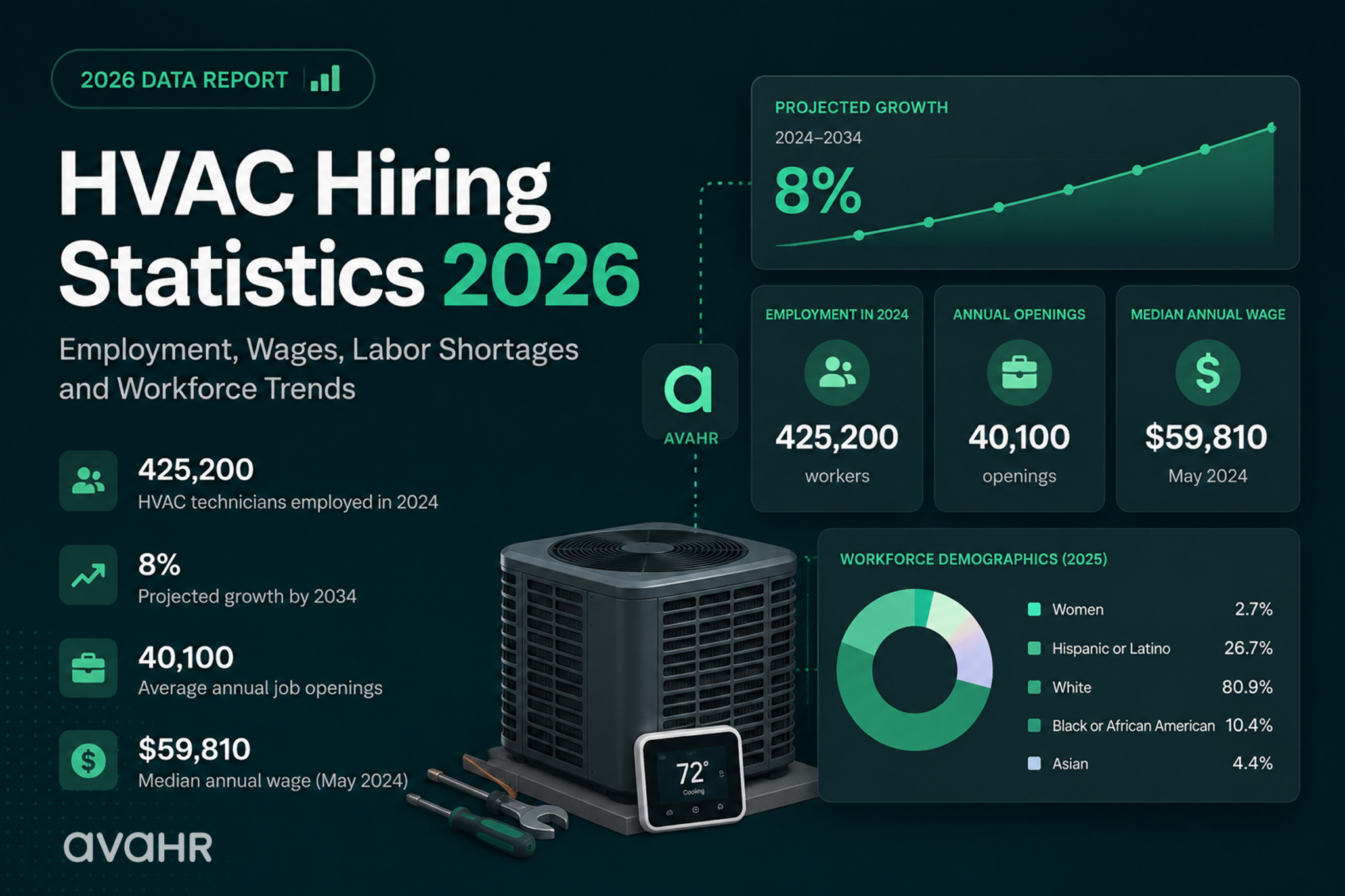
Key HVAC Hiring Statistics for 2026
| Statistic |
Latest figure |
| HVAC mechanics and installers employed in 2024 |
425,200 |
| Projected employment in 2034 |
459,700 |
| Projected net new jobs, 2024–2034 |
34,500 |
| Projected employment growth, 2024–2034 |
8% |
| Average projected openings per year |
40,100 |
| Median annual wage, May 2024 |
$59,810 |
| Median hourly wage, May 2024 |
$28.75 |
| Women in the workforce, 2025 |
2.7% |
| Hispanic or Latino workers, 2025 |
26.7% |
| Median age, 2025 |
39.9 years |
Sources: BLS Occupational Outlook Handbook, BLS Current Population Survey Table 11 and BLS Current Population Survey Table 11b.
HVAC Employment Statistics
How many HVAC technicians work in the United States?
Approximately 425,200 heating, air conditioning and refrigeration mechanics and installers held jobs in the United States in 2024. The Bureau of Labor Statistics groups these workers under Standard Occupational Classification code 49-9021.
The occupation includes technicians who install, maintain and repair heating, air-conditioning, ventilation and refrigeration systems. Employers may use titles such as HVAC technician, HVAC service technician, HVAC installer, refrigeration technician, HVAC mechanic, commercial HVAC technician or residential HVAC technician.
The 425,200 figure should not be interpreted as the entire HVAC industry workforce. HVAC companies also employ dispatchers, customer-service representatives, salespeople, warehouse workers, managers, helpers and office personnel who fall under other occupational classifications.
How quickly is HVAC employment projected to grow?
| Employment category |
Projected growth, 2024–2034 |
| HVAC mechanics and installers |
8% |
| Installation, maintenance and repair occupations |
5% |
| All U.S. occupations |
3% |
Source: BLS Occupational Outlook Handbook.
Federal projections estimate that HVAC employment will reach approximately 459,700 workers by 2034. That represents about 34,500 net new jobs and an 8% growth rate over the decade.
Worth noting: The projected HVAC growth rate is approximately five percentage points higher than the projection for all U.S. occupations.
How many HVAC job openings are expected each year?
Approximately 40,100 HVAC openings are projected each year, on average, during the 2024–2034 period. This number is much larger than the average annual increase in total employment because openings include both newly created jobs and replacement needs.
- Growth openings are created when employers add new positions.
- Replacement openings occur when workers retire, leave the labor force or transfer into other occupations.
The 40,100 annual openings are equivalent in scale to approximately 9.4% of 2024 occupational employment. This is a contextual ratio, not a projected annual employment-growth rate or a direct measure of turnover.
Where HVAC Technicians Work
Plumbing, heating and air-conditioning contractors employ approximately 70% of all HVAC mechanics and installers. Self-employed workers account for another 5%.
| Employer category |
Share of HVAC employment |
| Plumbing, heating and air-conditioning contractors |
70% |
| Self-employed workers |
5% |
| Wholesale trade |
3% |
| Educational services |
3% |
| Retail trade |
3% |
Applied to the rounded 2024 employment estimate, the 70% contractor share represents roughly 297,600 workers, while the 5% self-employed share represents roughly 21,300. These derived headcounts should be treated as approximations because BLS publishes the employer shares as rounded percentages.
HVAC technicians work in homes, schools, hospitals, offices, restaurants, hotels, industrial facilities, retail locations and commercial refrigeration environments. Some primarily install new systems, while others focus on maintenance, troubleshooting, emergency service or replacement work.
HVAC Salary Statistics
What is the median HVAC technician salary?
The median annual wage for heating, air-conditioning and refrigeration mechanics and installers was $59,810 in May 2024, equivalent to $28.75 per hour.
The median is the midpoint of the wage distribution: half of workers earned more and half earned less. It is not the same as an average wage or a typical starting wage.
| Employment category |
Median annual wage |
| HVAC mechanics and installers |
$59,810 |
| Installation, maintenance and repair occupations |
$58,230 |
| All U.S. occupations |
$49,500 |
Source: BLS Occupational Outlook Handbook.
The HVAC median was $1,580 higher than the median for the broader installation, maintenance and repair category and $10,310 higher than the median across all U.S. occupations.
How much do the highest-paid HVAC technicians earn?
The lowest-paid 10% of HVAC mechanics and installers earned less than $39,130, while the highest-paid 10% earned more than $91,020. The published upper-decile threshold is $51,890 higher than the lower-decile threshold.
Individual earnings may vary based on factors such as experience, credentials, location, type of work and employer compensation practices, including:
- Experience
- Certifications
- Geographic market
- Residential or commercial work
- Refrigeration expertise
- On-call responsibilities
- Overtime
- Performance incentives
- Supervisory duties
Which HVAC employer categories pay the most?
| Industry |
Median annual wage |
| Wholesale trade |
$65,760 |
| Educational services |
$60,960 |
| Retail trade |
$60,730 |
| Plumbing, heating and air-conditioning contractors |
$58,750 |
Is There an HVAC Labor Shortage?
There is no single official federal statistic that measures a nationwide HVAC technician shortage. The available data does, however, show substantial and recurring hiring demand.
- HVAC employment is projected to grow faster than the average for all occupations.
- Employers are expected to fill approximately 40,100 openings each year.
- Many openings are expected to come from workers transferring occupations or leaving the labor force.
- New technicians generally require postsecondary preparation and lengthy on-the-job training.
- The work combines technical, physical, customer-service and regulatory requirements.
These conditions can contribute to difficulty hiring qualified technicians in particular local markets. Local conditions may differ depending on construction activity, population growth, climate, compensation and competition among employers. They do not establish one nationwide shortage total.
Why can HVAC positions be difficult to fill?
HVAC work requires a combination of mechanical ability, problem solving, mathematics, attention to detail, customer service, physical stamina and technology skills. Technicians may work outdoors, in cramped spaces, during evenings or weekends and on emergency calls.
Experienced workers may pursue several related career paths, including field supervision, service management, estimating, technical sales, building controls, commercial refrigeration, facilities maintenance, training and business ownership. This can create competition not only among contractors, but also among adjacent career opportunities.
HVAC Workforce Demographics
The BLS Current Population Survey estimated approximately 561,000 employed people in this occupation in 2025. This figure is not directly comparable with the 425,200 employment estimate used in the Occupational Outlook Handbook because the CPS is a household survey, while the Occupational Outlook Handbook figure is based on a different statistical program, reference year and methodology.
What is the median age of an HVAC technician?
The median age of heating, air-conditioning and refrigeration mechanics and installers was 39.9 years in 2025.
| Age group |
Estimated workers |
| 16–19 |
12,000 |
| 20–24 |
55,000 |
| 25–34 |
159,000 |
| 35–44 |
135,000 |
| 45–54 |
95,000 |
| 55–64 |
77,000 |
| 65 and older |
28,000 |
An estimated 105,000 workers were age 55 or older, based on the rounded survey estimates.
What percentage of HVAC technicians are women?
Women represented approximately 2.7% of heating, air-conditioning and refrigeration mechanics and installers in 2025.
What are the racial and ethnic demographics?
| Demographic group |
Share of workforce |
| White |
80.9% |
| Black or African American |
10.4% |
| Asian |
4.4% |
| Hispanic or Latino |
26.7% |
Note: Hispanic or Latino ethnicity may overlap with the racial categories, so these percentages should not be added together.
Sources: BLS CPS Table 11 and BLS CPS Table 11b.
HVAC Education and Training Statistics
What education does an HVAC technician need?
The typical entry-level education for an HVAC mechanic or installer is a postsecondary nondegree award. Technical schools, trade schools and community colleges commonly offer HVAC programs lasting from six months to two years.
Some employers consider candidates with a high school diploma, and some technicians enter through apprenticeships. Newly hired technicians typically complete a lengthy period of on-the-job training while working alongside experienced technicians.
What skills do HVAC technicians need?
Training and supervised work may cover areas such as:
- Electrical circuits
- Piping
- Refrigerant systems
- Diagnostics
- System controls
- Equipment installation
- Preventive maintenance
- Customer communication
Can HVAC technicians train through apprenticeships?
Yes. Some HVAC technicians enter the occupation through apprenticeships that combine paid employment, technical instruction and supervised work experience. BLS notes that these programs usually last several years and may cover safety practices, blueprint reading, heating and cooling systems, tools and equipment.
People seeking apprenticeship opportunities can use the Apprenticeship Job Finder.
HVAC Certification Requirements
Do HVAC technicians need EPA certification?
Technicians who maintain, service, repair or dispose of equipment that could release regulated refrigerants generally must hold the appropriate EPA Section 608 Technician Certification.
| Certification type |
Covered equipment |
| Type I |
Small appliances |
| Type II |
High- or very-high-pressure appliances, excluding small appliances and motor-vehicle air conditioning |
| Type III |
Low-pressure appliances |
| Universal |
All covered equipment types |
Section 608 credentials do not expire. Apprentices may perform covered work before certification when they are closely and continually supervised by a properly certified technician and meet the applicable exemption requirements.
Source: U.S. Environmental Protection Agency Section 608 requirements.
Why HVAC Hiring Demand Is Expected to Remain Strong
New construction
New homes, offices, hospitals, schools, retail spaces and industrial facilities require heating, cooling, ventilation and refrigeration systems.
Repair and replacement of existing systems
Repair and replacement are recurring parts of HVAC work. Existing systems require maintenance and eventually may need major repair or replacement, which can support demand even when new construction slows.
More sophisticated climate-control systems
Modern systems increasingly use computerized components, networking features, sensors, variable-speed equipment, connected thermostats and building-automation controls.
Energy-efficiency upgrades
BLS expects the emphasis on energy efficiency and pollution reduction to support demand as climate-control systems are retrofitted, upgraded or replaced.
Recurring service and seasonal peaks
HVAC systems require ongoing inspection, cleaning, testing and repair. Because service demand can be seasonal and urgent, employers may benefit from maintaining an active recruiting pipeline.
HVAC Recruiting Metrics Employers Should Track
| Metric |
What it measures |
| Applicants per job |
Completed applicants generated for each opening |
| Qualified-applicant rate |
Percentage of applicants meeting minimum requirements |
| Speed to first contact |
Time from application to the first personalized response |
| Interview conversion rate |
Percentage of applicants who reach an interview |
| Interview show rate |
Percentage of scheduled candidates who attend |
| Offer-acceptance rate |
Percentage of formal offers accepted |
| Time to hire |
Days from application or job approval to accepted offer |
| Cost per hire |
Recruiting costs divided by completed hires |
| Source of hire |
Channel that originally produced each hired candidate |
| New-hire retention |
Percentage of hires still employed after 30, 90, 180 and 365 days |
What These HVAC Statistics Mean for Employers
Maintain an always-on technician pipeline
A company that starts recruiting only after a technician resigns may operate below its preferred staffing level while the role remains open. Consistent sourcing, referrals and candidate communication can reduce the time needed to respond when a vacancy appears.
Balance experienced hiring with entry-level development
Experienced technician recruiting should be supported by apprentice hiring, trade-school partnerships, employee referrals, internal training, structured career paths and supervisor development.
Make job postings competitive and transparent
Strong postings should clearly explain details that influence whether a technician applies, including:
- Compensation range
- Overtime expectations
- On-call schedule
- Benefits
- Company vehicle policy
- Tools and allowances
- Training and certifications
- Career progression
- Type of work
- Service area
Keep mobile applications simple
Many candidates use mobile devices during the job-search process. A short, mobile-friendly application can reduce unnecessary candidate drop-off.
Move quickly without removing structure
A practical hiring process may include a short application, fast initial review, phone screen, structured interview, license and certification verification, a technical assessment when appropriate, reference or background checks, a written offer and consistent preboarding communication.
Treat retention as part of recruiting
Onboarding, manager quality, dispatch practices, scheduling, safety, compensation transparency, training, career development and workload management all affect whether a successful hire becomes a long-term employee.
Frequently Asked Questions About HVAC Hiring
How many HVAC technicians are employed in the United States?
Approximately 425,200 HVAC mechanics and installers held jobs in the United States in 2024.
How many HVAC jobs will be added by 2034?
Employment is projected to increase by approximately 34,500 jobs, reaching about 459,700 workers in 2034.
What is the projected growth rate for HVAC technicians?
HVAC technician employment is projected to grow 8% from 2024 to 2034, compared with 3% for all occupations.
How many HVAC job openings are projected each year?
BLS projects approximately 40,100 HVAC openings annually, on average, over the 2024–2034 decade.
What is the median HVAC technician salary?
The median annual wage was $59,810 in May 2024, equivalent to $28.75 per hour.
Is there an HVAC technician shortage?
Federal data does not publish a single nationwide shortage total. The combination of faster-than-average growth, 40,100 projected annual openings, lengthy training requirements and replacement needs does show substantial ongoing hiring demand.
How long does it take to train an HVAC technician?
Postsecondary programs commonly last from six months to two years. Newly hired technicians typically also complete a lengthy period of on-the-job training.
Do HVAC technicians need a college degree?
A four-year degree is generally not required. The typical entry-level education is a postsecondary nondegree award.
Does an HVAC technician need EPA certification?
Technicians who service, maintain, repair or dispose of equipment that could release regulated refrigerants generally need the appropriate EPA Section 608 certification.
Does EPA Section 608 certification expire?
No. Section 608 Technician Certification credentials do not expire.
Methodology and Sources
This report was updated in July 2026 using the most recent national release available from each source. The 425,200 figure is the 2024 employment base estimate used in federal occupational projections. The 2025 Current Population Survey demographic estimate comes from a household survey and is not directly comparable. Different government datasets may report different totals because they use different methodologies, samples, reference periods and definitions.
About AvaHR
AvaHR is hiring software built to help small and midsize businesses attract applicants, organize candidates and move qualified people through the hiring process.
HVAC and home-service companies can use AvaHR to publish openings across multiple job boards, centralize applicant information, communicate with candidates and track recruiting performance from one system.
Build a faster, more organized HVAC hiring process.
See how AvaHR can help your team attract and manage qualified applicants.
Explore AvaHR
Citation Guidance
Journalists, researchers and industry organizations may cite this report as:
AvaHR, “HVAC Hiring Statistics 2026: Latest Employment, Wage and Workforce Data.”
When citing an individual government statistic, readers should also review the original source and reporting year linked in this report.