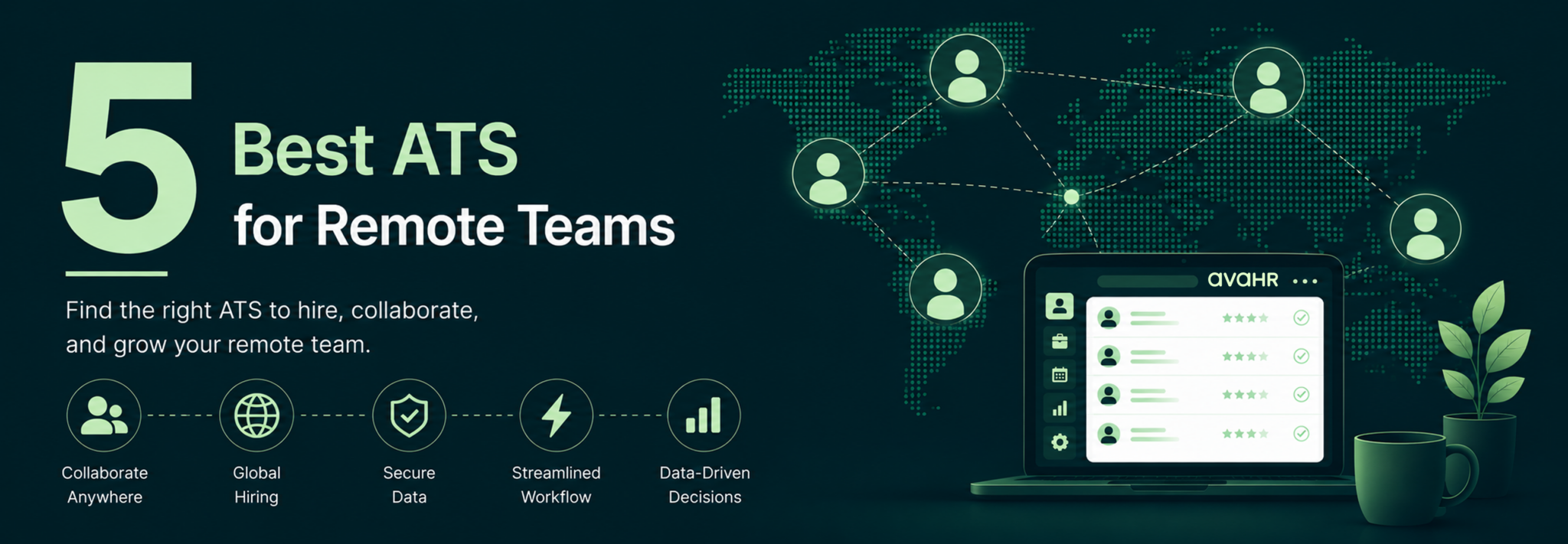
5 Best ATS for Remote Teams in 2026
Hiring remotely feels manageable until several roles, hiring managers, and time zones are involved at the same time.
You know that feeling when gaps start slowing everything down? Feedback arrives late. Candidate updates get missed. Recruiters spend more time following up internally than moving people forward.
💡That’s usually the moment you ask one question: Is there an ATS that can help our remote team stay organized long-term?
So, to ease your dread of the next hiring cycle, in the table below are the best ATS options for remote teams you should consider in 2026.
Best ATS for Remote Teams at a Glance
| ATS Platform |
Best For |
What It Feels Like as Hiring Grows |
Starting Price |
| AvaHR |
Growing remote teams and SMB hiring |
Stays organized without becoming operationally heavy
|
$99/month
|
| Breezy HR |
Visual recruiting workflows |
Easy to adopt, though larger hiring teams may want more structure over time |
Free plan available |
| Ashby |
Data-driven recruiting teams |
Powerful at scale, though the learning curve can feel heavier for smaller teams |
Starts around $400/month |
| Greenhouse |
Enterprise hiring operations |
Consistent and structured, though often requires more process ownership |
Custom pricing |
| Workable |
Companies hiring across multiple roles |
Handles active recruiting well, though costs can increase as hiring expands |
Starts around $299/month |
So, what does your remote team actually need from an ATS?
Most hiring software promises similar things on the surface.
Automation. AI features. Analytics. Collaboration tools. Integrations. 🥱
After a while, the feature lists start sounding almost identical.
What matters more in day-to-day hiring is whether the platform helps your remote team stay aligned without constant follow-ups, scattered communication, and process confusion.
When hiring starts involving multiple people across different locations and time zones, the ATS becomes the place where recruiting either stays organized or starts creating more operational chaos.
Hiring managers should not need a refresher every time they open the ATS
Hiring managers usually don’t live inside the ATS every day.
They step in when interviews are scheduled, feedback is needed, or a role suddenly becomes urgent again.
So, if the platform feels confusing, people avoid using it consistently, which results in delayed feedback, manual follow-up, and candidates who wait way more than they should be.
Interview scheduling often becomes part of that problem too. When recruiters are coordinating calendars, chasing feedback, and trying to keep interviews moving, small delays can quickly add up. If this sounds familiar, explore these ATS platforms with interview scheduling designed to help teams reduce hiring bottlenecks.
The best ATS platforms for remote teams make the next step obvious.
People should quickly understand:
- where candidates are
- what stage comes next
- where feedback belongs
- who owns the next action
That kind of clarity becomes far more valuable once multiple people are involved in hiring. If keeping recruiters, hiring managers, and stakeholders aligned is a challenge for your team, explore our guide to the best ATS for collaborative hiring.
👉 If you’re prioritizing simplicity, you may also want to explore these easy-to-use ATS platforms.
Long-term usability matters more than demo-day features
You are probably familiar with the fact that many ATS platforms look impressive during a demo.
So, the more important question is how the system feels after months of real hiring activity.
That is usually when teams discover whether the platform can comfortably support:
- more open roles
- more hiring managers
- more interview coordination
- more candidate communication
- more moving parts across the hiring process
Note: Candidate communication often becomes a bigger challenge as hiring activity grows. If keeping candidates engaged is becoming difficult, explore our guide to the best text recruiting software platforms.
In day-to-day hiring, some platforms simply become harder to manage as workflows grow.
Fortunately, there are platforms that continue feeling clear and manageable even during busier hiring periods.
So, in the sections below, you can explore some really good ATS platforms for your remote hiring.
1. AvaHR
Best for: Growing remote teams that want hiring to stay organized without adding unnecessary complexity
We’re admittedly a little biased here, but AvaHR works especially well for remote and distributed teams because it gives hiring teams structure without making the process feel heavy.
And that balance matters.
Smaller teams often need something more reliable than spreadsheets and inboxes, but they may not want an enterprise-style system that requires a lot of setup, training, and ongoing administration.
So, AvaHR gives remote teams a clear place to manage applicants, collaborate with hiring managers, collect feedback, automate communication, and keep candidates moving through the pipeline.
Remote teams can use AvaHR to:
- build custom hiring pipelines
- centralize interview feedback
- automate candidate communication
- organize candidate profiles
- collaborate with team notes and scorecards
- post jobs across 50+ free job boards
- track hiring activity from one dashboard
✅ For startups and growing SMBs, AvaHR offers a practical middle ground: simple enough to adopt quickly, but capable enough to support hiring as the team grows.
👉 Try free AvaHR trial and see how hiring can stay organized as your team grows >
Note: Teams evaluating startup-friendly hiring software can also review these best ATS platforms for startups.
2. Breezy HR
Best for: Teams that want visual hiring workflows and quick setup
Breezy HR is a good option for teams that want a clean, visual way to manage candidates.
Its pipeline-style interface is easy to understand, which can be helpful for smaller remote teams that want to get started quickly.
For companies hiring occasionally or managing a lighter recruiting process, Breezy HR can feel simple and approachable.
As hiring grows, some teams may want more structure around collaboration, reporting, and process consistency.
That is where the platform may feel less ideal for larger remote hiring teams with multiple stakeholders involved across several roles.
Breezy HR still makes sense for companies that value visual workflows and fast adoption.
👉 Compare plans and hiring costs in this Breezy HR pricing guide.
3. Ashby
Best for: Recruiting teams that want advanced analytics and operational depth
Ashby is a strong platform for companies with mature recruiting operations.
It is especially popular with scaling tech companies and recruiting teams that want detailed reporting, flexible workflows, analytics, and deeper operational control.
For larger remote teams with dedicated recruiting owners, that level of depth can be useful.
For smaller companies, Ashby may feel like more system than they need early on.
The platform is best suited for teams that already have structured hiring processes and want a powerful system to manage them.
If your company is still building its recruiting foundation, the setup and operational depth may feel like a heavier lift.
👉 Teams comparing scalability and recruiting analytics can review this Ashby pricing breakdown.
4. Greenhouse
Best for: Larger organizations with structured hiring operations
Greenhouse is one of the most established ATS platforms for enterprise recruiting.
It is known for structured hiring workflows, interview consistency, integrations, and process control across larger organizations.
For remote companies with mature hiring systems, Greenhouse can help standardize recruiting across departments and locations.
The tradeoff is that smaller teams may find the platform heavier than they need.
Implementation, workflow setup, and ongoing administration can require more internal ownership than lean teams want to manage.
Greenhouse is often a better fit for organizations with dedicated recruiting operations, formal hiring processes, and larger hiring volume.
👉 This Greenhouse ATS pricing guide breaks down costs and platform considerations in more detail.
5. Workable
Best for: Companies managing active recruiting pipelines across multiple roles
Workable is a well-known ATS with a broad feature set for sourcing, evaluating, and managing candidates.
Remote teams with active hiring pipelines may appreciate its structure, collaboration tools, and recruiting functionality.
It can be a good fit for companies that want a more established system and expect to manage multiple openings at once.
Pricing is one area growing teams should look at closely.
Workable’s entry pricing starts around $299/month, and costs can increase as hiring volume, plan needs, and add-ons expand.
For some SMBs, that can make the platform feel more expensive as the team grows.
Workable remains a strong choice for teams that want structured recruiting workflows and broad ATS functionality.
👉 Compare plans and platform costs in this Workable pricing breakdown.
How to pick the right ATS for your remote team
The best ATS for remote teams should make hiring easier to follow for everyone involved. It’s as simple as that.
Before choosing a platform, look beyond the feature list and ask how the system will feel during a busy hiring month.
Consider whether your team can easily:
- see where every candidate stands
- collect interview feedback on time
- communicate with applicants consistently
- collaborate without switching between too many tools
- keep hiring organized as more roles open
Remote teams usually benefit most from software that feels clear, collaborative, and sustainable over time.
Note: Teams exploring lower-cost recruiting software can also review these free ATS systems for growing companies.
Remote hiring is hard enough without chasing everyone for updates
Remote hiring has a way of scattering information across tools.
A Slack message here. Interview notes there. Feedback that never gets submitted. Someone forgetting they’re supposed to review a candidate.
Before you know it, recruiters spend more time tracking updates than moving candidates forward.
✅ The right ATS helps everyone stay on the same page without constant reminders.
That’s what AvaHR is built for.
👉 Try AvaHR free for 7 days and see how much smoother hiring feels when everything lives in one place >
Frequently Asked Questions
Which ATS is best for a small remote team?
The best ATS for a small remote team is usually one that balances simplicity with room to grow. Many teams start with spreadsheets or lightweight tools, but those systems often become harder to manage as hiring volume increases.
Platforms like AvaHR, Breezy HR, and Workable are popular choices for smaller remote teams because they help centralize candidate communication, interview feedback, and hiring workflows. The right choice depends on your hiring goals, budget, and how many people are involved in the recruiting process.
Do remote teams need a different ATS?
Not necessarily, but remote teams often have different priorities than office-based hiring teams.
When people work across locations and time zones, visibility becomes more important. Recruiters, hiring managers, and interviewers need a shared place to track candidates, leave feedback, and stay aligned throughout the hiring process.
An ATS that supports collaboration, clear workflows, and centralized communication can help remote teams avoid delays and keep hiring moving smoothly.
How much does an ATS for remote teams cost?
ATS pricing varies widely depending on the platform and team size.
Some providers offer free plans, while others start around $100 per month and increase as hiring needs grow.
For example:
- AvaHR starts at $99/month
- Workable plans start around $299/month
- Ashby plans start around $400/month
- Greenhouse uses custom pricing
When comparing costs, it is helpful to look beyond the monthly fee and consider how much time the software can save your recruiting team.
What should I look for in an ATS for remote teams?
The most important features are often the ones that make collaboration easier.
Look for an ATS that helps your team:
- track candidate progress clearly
- collect interview feedback efficiently
- communicate with applicants consistently
- collaborate across departments
- maintain visibility as hiring grows
Many ATS platforms offer similar feature sets. The biggest difference is often how easy the system is to use day-to-day once multiple people become involved in the hiring process.
Can an ATS help reduce hiring delays?
Yes.
One of the biggest causes of hiring delays is lack of visibility. Candidates get stuck waiting for feedback, interview notes are spread across different tools, and recruiters spend time following up internally instead of moving candidates forward.
A well-organized ATS helps keep everyone aligned by centralizing communication, feedback, and candidate information in one place. This makes it easier to identify bottlenecks, respond to candidates faster, and maintain momentum throughout the hiring process.